


The Ultimate Guide to Writing an Internship CV in Sri Lanka
- Intern Guide
- April 29, 2026
-
- 0
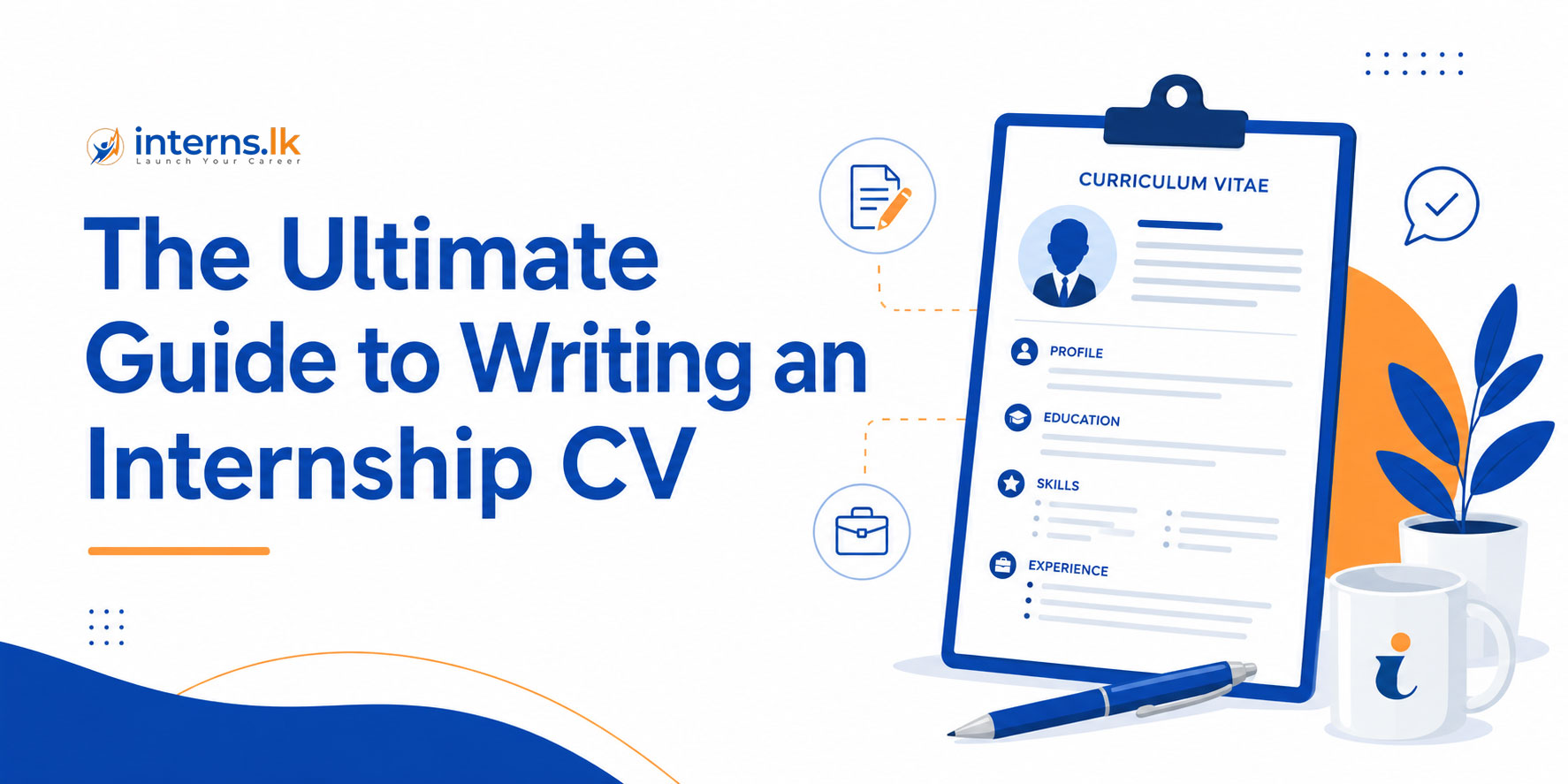
You've applied. Nobody called.
You sent your CV to five companies last month. Maybe ten. You checked your email every morning. Nothing.
This happens to most students in Sri Lanka. Not because they are unqualified. Not because the market is too competitive. It happens because the CV they sent was never going to get a response in the first place.
That is the part nobody tells you upfront. The problem is not you. The problem is the document you used to introduce yourself.
This guide will show you exactly how to fix that.
Why Your CV Is Getting Ignored
Companies receive a large number of applications for every internship opening. The person reviewing them does not have time to read each one carefully. They scan. They look for specific things. If those things are not visible within a few seconds, the CV goes into the rejection pile.
Most student CVs fail for the same set of reasons:
The structure is hard to follow. The content is generic and says nothing specific. The length is either too long with unnecessary filler or too short to show anything meaningful. Skills are listed without context. And in many cases, the CV never even reaches a human reviewer because it does not pass the company's initial filtering process.
Knowing this is the first step. The second step is doing something about it.
What Companies Are Actually Looking For
Here is something that should take pressure off you: companies offering internships are not expecting experience. They know you are a student.
What they want to see is whether you can communicate clearly, whether your skills are relevant to the role, whether you have the attitude to learn, and whether your CV looks professional enough to take you seriously.
That is it. Your job is to show those four things, quickly and clearly.
The CV Structure That Works in Sri Lanka
This is the format that consistently performs well when applying to local companies.
1. Personal Details
Keep this clean and at the top. Your full name, a phone number you actually answer, a professional email address, and your LinkedIn profile if you have one. That is all you need here.
A professional email means something like [email protected]. Not nicknames, not numbers from your school days.
2. Career Objective
This section gets ignored by most students or filled with something that says absolutely nothing. That is a wasted opportunity.
The wrong way to write it: "I am a hardworking and dedicated student seeking an internship opportunity to gain experience."
Every single applicant writes something like that. It tells the reader nothing about you, the role, or why you are applying.
The right way: "Business management undergraduate seeking a marketing internship to apply knowledge in digital campaigns and consumer behaviour analysis, and contribute to real brand outcomes."
You named your field. You named the type of role. You mentioned something specific you want to apply. That already makes you stand out.
3. Education
List your degree or programme, the university or institute, the year you are in or when you graduated, and optionally a few key subjects that are relevant to the role you are applying for. No need to list every subject. Pick the ones that match.
4. Skills
This section should be honest and specific. Communication skills, Microsoft Office or Google Workspace, and any practical skills relevant to the role you want, whether that is marketing, IT, finance, or something else.
Do not list skills just to fill space. If it is not relevant to the role, it is not helping you.
5. Projects and Experience
This is where students with no formal work experience tend to leave the section blank. That is a mistake.
You do not need a job title to fill this section. University projects count. Group assignments count. Any freelance work you did for a small fee or even for free counts. Personal projects you built on your own count.
What this section needs to do is show that you have applied your knowledge somewhere, even in a small way. That is what hiring managers are looking for when they read it.
6. Extra Activities
Clubs you were part of, volunteer work, competitions you participated in. These are not decoration. They signal that you are someone who shows up, takes initiative, and can work with other people. Include them.
Mistakes That Will Get Your CV Rejected Immediately
These are specific things to avoid:
Using a CV template you downloaded without changing anything. If it looks exactly like a template, it reads like one too.
Writing long paragraphs. Use short sentences or brief bullet points. Make it easy to scan.
Adding personal information that is not relevant, like your religion, marital status, or a photo when one was not requested.
Spelling mistakes and grammar errors. One or two of these and the reader has already made up their mind about you.
These are all fixable. But they need to be fixed before you apply, not after you wonder why no one is responding.
The Problem Most Students Do Not Know About
Even if your CV is well-structured, there is something else that can stop it from being seen.
Many companies today use digital filtering before any human reviews applications. Your CV may be getting filtered out automatically based on keywords, formatting, or file type, before it ever reaches a recruiter.
This means a CV that looks good to you may still be invisible to the company. Knowing this matters because it changes how you write and format your document.
How to Know If Your CV Is Ready
Before you apply anywhere, run your CV through a basic check:
Is the structure clear and easy to follow? Does it include keywords relevant to the specific role? Can someone scan it in ten seconds and understand who you are and what you want? Does it read cleanly without spelling errors or formatting issues?
If you want an objective assessment rather than your own guess, our free CV analysis tool at Intrns.lk will score your CV and show you exactly where it is falling short.
If You Want It Done Properly
Some students prefer to rewrite their CV from scratch with professional input. If that is where you are, we offer a CV writing service that is built specifically for internship applicants in Sri Lanka. We restructure, rewrite, and optimise your CV to meet current hiring standards.
The service is available at Rs. 5,000 as a limited offer. If you are serious about getting shortlisted, this is worth considering.
The Bottom Line
The internship market in Sri Lanka is competitive, but it is not impossible to break into. Most students are being filtered out at the CV stage, which means fixing that one thing immediately improves your position relative to the majority of applicants.
You do not need more qualifications. You do not need more experience. You need a CV that does its job.
Fix the CV first. Everything else follows from there.
Ready to find out how your current CV is performing? Try the free CV analysis tool on Intrns.lk and see your score before your next application.